The Movement
The Beginning
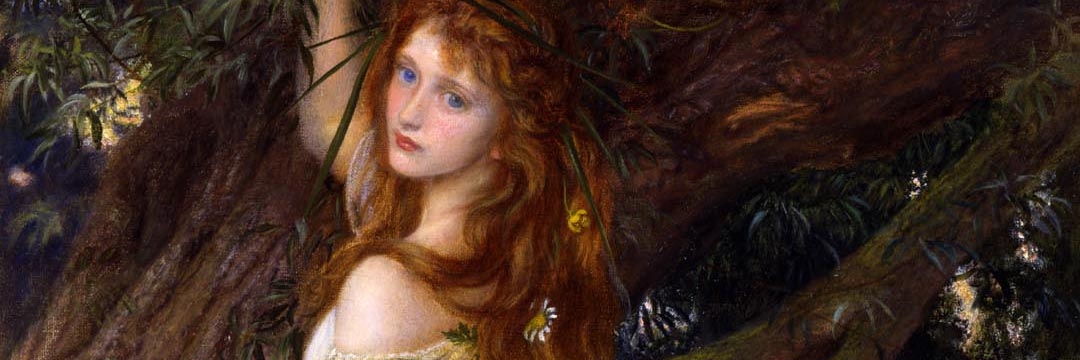
The Pre-Raphaelite movement began with the Pre-Raphaelite Brotherhood, founded in 1848 by John Everett Millais, Dante Gabriel Rossetti, and William Holman Hunt, all painters. They wanted to challenge the dominant modes of painting, especially those taught at the British Royal Academy, which emphasized rote learning and idealizing subjects in the style of the late Renaissance. They proposed a return to medieval and early Renaissance subjects and modes, especially in the face of the growing industrialization of England.
The Brotherhood’s doctrines were written as such by William Michael Rossetti:
- to have genuine ideas to express;
- to study Nature attentively, so as to know how to express them;
- to sympathise with what is direct and serious and heartfelt in previous art, to the exclusion of what is conventional and self-parading and learned by rote;
- and most indispensable of all, to produce thoroughly good pictures and statues.
Millais, Rossetti, and Hunt were the original three members. Four more were inducted in the autumn of 1848 - painter James Collinson, sculptor and poet Thomas Woolner, and critics Fredric George Stephens and William Michael Rossetti - forming the seven.
The End
Due to their push against the norms in the art world, the Brotherhood would attract some trouble. Their style was lambasted as backwards-looking and jarring to the eye. Millais’s painting Christ in the House of His Parents attracted scorn due to his depiction of the Holy Family as normal peasants. Author Charles Dickens called Millais’s Mary ugly, and suggested the depiction of her as anything other than an idealized beauty was blasphemy.
Following the disastrous exhibition of Millais’s piece, John Collinson left the Brotherhood. The group would never exhibition together again, and ultimately disbanded in 1853.
The Legacy
The influence of the Pre-Raphaelites would be felt in art for years after their break up. Most of the members continued to work in their distinctive styles even after leaving the group. The Brotherhood had many associates and followers who that used their style, such as Evelyn de Morgan, Ford Madox Brown, and Fredric Sandys. Thanks to them and others, the Pre-Raphaelite style continued into the 1890s and beyond.
Artists like Edward Burne-Jones and Aubrey Beardsley brought the influence of the Pre-Raphaelites into the Aesthetic, Decadent, and Art Nouveau movements later. William Morris, by way of Dante Gabriel Rossetti, would bring their ideas to interior design through the Arts and Crafts movement. It’s been theorized that their art influenced the aesthetic of J.R.R. Tolkein’s Middle Earth, which would inspire many fantasy writers in turn.